Justice Suraj Govindaraj ruled that the state cannot exploit a mistake made by a citizen in categorising the land as ‘sagu bane land’ when it was, in fact, alienated ‘sagu bane land’, and retain the deposited amount.
Representative image showing a forest./ Credit: DH Photo
Bengaluru:
The Karnataka High Court has directed the Forest Department to refund Rs 4.33 lakh, along with 6 per cent interest, to the legal heirs of a Kodagu landowner, Mahabaleshwar Bhat, who had deposited the amount in 1982.
Justice Suraj Govindaraj ruled that the state cannot exploit a mistake made by a citizen in categorising the land as ‘sagu bane land’ when it was, in fact, alienated ‘sagu bane land’, and retain the deposited amount.
Bhat, who owned 38.5 acres in Biligeri Village, Madikeri taluk, Kodagu district, had received permission on February 1, 1983, to cut 349 trees on the property. He subsequently paid Rs 4,33,082, the assessed value of the trees. However, he later realised that the land had been classified as alienated ‘sagu bane land’ since 1897, making the payment unnecessary.
Bhat requested a refund from the authorities, but his plea was rejected by the Forest Department on April 25, 2012, citing the Karnataka Land Revenue Act, 1964, as grounds for denial. After the department’s appellate authority also dismissed his appeal, Bhat moved the high court.
During the pendency of the case, Bhat passed away and his legal representatives were substituted as petitioners in 2023. The court found that the Forest Department failed in its duty to verify the land’s classification.
“In fact, it was for the assistant and chief conservator of forest to verify these from the records concerned and not go by the statement made by the petitioner himself. Whenever any application is filed by any person claiming permission to cut trees, there is a duty imposed on the authority granting such permission to verify the details. If at all the details had been verified, it would have been clear that the land in question is alienated ‘sagu bane land’ and not un-alienated ‘sagu bane land’.
This aspect has been made clear by the deputy commissioner in his order dated March 29, 2010,” Justice Suraj Govindaraj said.
source: http://www.deccanherald.com / Deccan Herald / Home> India> Karnataka / by Subarna Mukherjee , DH Web Desk / January 03rd, 2025
It will be a welcome relief for coffee growers as they are currently bound by international standards.
The certification process involves checking if coffee producers follow guidelines that focus on quality, the environment, and social practices.(Representative image)
Bengaluru :
In a first, the Coffee Board is set to introduce India’s own coffee standards and certification process to recognise the country’s unique coffee varieties.
Coffee standards are rules set to ensure that the produce is grown, processed, and sold in a way that is consistent, of good quality, and enjoyable to drink. These standards cover everything from how coffee is grown and harvested to how it is processed and packed and evaluated for taste and aroma. The certification process involves checking if coffee producers follow guidelines that focus on quality, the environment, and social practices.
Till now, Indian growers were bound by international standards that did not account for the unique conditions in which their coffee thrives, such as cultivation under two-tier thick tree shade.
The board has introduced this plan in response to the high costs of certification, which have hindered many growers from showcasing their coffee internationally. With nearly 85% of Indian coffee remaining uncertified due to lakhs of rupees in costs for international certification, the new Indian standards will come as a welcome relief as certification will now be free, offering a significant opportunity for growers.
Dr KG Jagadeesha, secretary and CEO of the Coffee Board of India, told TNIE that the process is currently in its first stage and aims to position Indian coffee as a unique product with its own distinct identity. “Until now, most coffee varieties have been certified under international standards, which group all types of coffee together under the same conditions. However, Indian coffee is grown in special conditions.
This certification process will recognise and highlight these unique growing conditions, helping Indian coffee stand out and gain its own global recognition,” he said.
Dr Jagadeesha said the cost of certifying, as per international standards even for a small five-acre estate, can range from Rs 3-4 lakh, while board’s certification will be of zero-cost. Growers have to meet strict requirements, filling in various gaps to ensure that their plantations are sustainable.
While experts and a technical core team have finished developing documents, industry professionals are currently drafting the implementation modules, which will be completed in four months, Dr Jagadeesha said.
After this, the technical team will hold consultations with stakeholders and innovative growers to assess whether the procedures are feasible. The process will involve meeting several parameters. Once the estate meets the requirements, an external inspector will visit them for a final assessment.
source: http://www.newindianexpress.com / The New Indian Express / Home> Bengaluru / by Rishita Khanna / January 03rd, 2024
Thomas Cook (India) subsidiary, Sterling Holiday Resorts, has expanded its presence in Karnataka with the launch of Sterling Brookstone Coorg. Located near Madikeri in the Western Ghats, the new property provides villa and cottage-style accommodations, combining modern conveniences with natural beauty.
Sterling Brookstone, a resort in Coorg, offers an array of amenities such as a swimming pool, banquet facilities, and an on-site restaurant. The Planter’s Kitchen caters to all palates, serving both local Kodagu delicacies and international cuisine. The resort also offers easy access to local attractions including Abbey Falls, Madikeri Fort, and Dubare Elephant Camp, positioning it as a perfect destination for leisure travelers.
Sterling Holiday Resorts, which manages over 3,000 keys across 57 resorts, hotels, and retreats in 48 Indian destinations, recently acquired a new property that aligns with its vision of providing memorable experiences at key tourist spots. The company, owned by Fairfax Financial Holdings, operates under two brands – Sterling and Nature Trails, serving various segments including leisure travel, Meetings, Incentives, Conferences, and Exhibitions (MICE), destination weddings, and group tourism. The acquisition of the new property is seen as a significant step in expanding Sterling’s footprint in India’s tourism sector.
Sterling Holiday Resorts has expanded its portfolio with the addition of a new resort in Coorg, demonstrating its commitment to providing exceptional hospitality experiences.
source: http://www.constructionweekonline.in / Construction Week / Home> Projects & Tenders / by Staff Writer / January 04th, 2024
It is the duty of the forest authorities to verify official records before allowing applications seeking permission to cut trees, the High Court of Karnataka has said, while finding fault with the authorities for refusing to refund the amount deposited by a land owner by mistake, though he was not required to deposit it while seeking permission to cut trees on his land.
Justice Suraj Govindaraj passed the order while allowing a petition filed by N. Mahabaleshwara Bhat, a resident of Biligeri village in Madikeri taluk of Kodagu district.
The petitioner, who died during the pendency of petition filed in 2016, deposited ₹4.33 lakh with the forest authorities to seek permission to cut several trees on his Sagu Bane land.
However, he realised later that his was alienated Sagu Bane land for which there was no need to deposit money, and hence he requested the authorities to refund the deposited amount. But the forest authorities rejected his request, stating that he himself had described his land as Sagu Bane land in his application.
Negating the contention of the authorities, the court said that it was for the Assistant Conservator of Forest and the Chief Conservator of Forest to verify nature of the land from the records and not to go by the statement made in the application.
If at all the details of the land had been verified by the forest authorities, it would have been clear that the land in question was alienated Sagu Bane land as this aspect was made clear by the Deputy Commissioner in his order passed in 2010, the court said, while stating that there was a duty imposed on the authority to very the records before granting such permissions.
source: http://www.thehindu.com / The Hindu / Home> News> India> Karnataka / by The Hindu Bureau / January 03rd, 2024
Retired IAS officer, Rathi Vinay Jha, has been selected as Coorg Person of the Year 2024 in a poll conducted by a news and tourism portal, www.coorgtourisminfo.com.
With her roots in Kodagu district in Karnataka, Ms. Rathi Vinay Jha, a former Union Tourism Secretary, had initiated several projects to “conserve Kodava culture and the martial traditions of the comunity, known for its contributions to the nation in the areas of defence and sports,” author P.T. Bopanna, who runs the portal pointed out.
He said Ms. Rathi was instrumental in setting up the virtual museum of Kodava heritage and culture, the project known as Sandooka — a treasure trove of information.
“The virtual museum is an interactive online space, brought together through material contributed by the Kodava community. Sandooka will be a living museum of Kodava culture and will be useful for future generations of Kodavas.”
“It was at the instance of Ms. Rathi, a model of Kodava ainmane (ancestral house) was inaugurated this October in Dakshinachitra Museum near Chennai,” Mr. Bopanna said.
Dakshinachitra is home to 18 traditional houses that depict the unique culture of South India. The ainmane project involved dismantling a structure built in 1852 in Kodagu and was transported to Dakshinachitra Museum, said Mr. Bopanna.
source: http://www.thehindu.com / The Hindu / Home> News> India> Karnataka / by The Hindu Bureau / January 01st, 2025
Kanthur Friends team from Murnad (Maragodu) in Kodagu from Karnataka emerged victorious in the women’s throwball championship by defeating P G Pudur team from Coimbatore in straight sets.
Meanwhile, Alif Star team from Chikkamagaluru (seen in picture below) defeated Palli Friends team from Udupi in the men’s volleyball match in a thrilling contest.
The grand finale was held in the presence of the 112-foot-tall Adiyogi at the Isha Yoga Center in Coimbatore. The winning teams won a cash prize of ₹5 lakh, bringing the event to a grand close.
Along with Sadhguru, cricket legends Virender Sehwag and Venkatesh Prasad graced the historic occasion. Thousands of spectators from India and abroad came to watch the event.
Isha Gramotsava is a two-month sports festival held across the South Indian states of Karnataka, Andhra Pradesh, Telangana, Kerala, Tamil Nadu and the Union Territory of Puducherry.
Held in over 162 rural areas, the festival saw the participation of over 43,000 players.
More than 10,000 of them were rural women, most of whom were housewives – volleyball and throwball Participated in matches.
Started by Sadhguru in 2004, Isha Gramotsava aims to bring sports and the spirit of play into the lives of rural communities.
Apart from professional players, the festival provides a platform for ordinary rural people, including daily wage workers, fishermen and housewives, to step away from their daily activities and experience the celebration and unifying power of sports.
source: http://www.mysoorunews.com / Mysooru News / Home> General / by Mysooru News Desk / January 01st, 2025
Money paid from 2016-19, later two tried to alienate property gifted by petitioner to them
Karnataka High court. (File Photo)
Bengaluru :
The High Court of Karnataka has come to the rescue of an 85-year-old woman from Kodagu by ordering her son and granddaughter to pay her an annual maintenance of Rs 7 lakh each.
Justice M Nagaprasanna directed that the maintenance amount be paid to petitioner Apparanda Shanthi Bopanna by her third son AB Ganapathy and her late first son’s daughter Pooja, residents of Bengaluru.
Shanthi Bopanna had questioned the deputy commissioner’s order of March 22, 2022, under the Maintenance and Welfare of Parents and Senior Citizens Act.
“The order of the DC, which directs payment of maintenance to the petitioner, is sustained with a modification that the son and granddaughter would be entitled to enjoy the fruits of gift deeds executed by the petitioner, subject to the condition that they would pay her maintenance of Rs 7 lakh each every year till her lifetime,” the court said, while noting that the petitioner is not in a position to take care of her property after cancellation of the gift deeds.
Shanthi Bopanna, who is a resident of Heroor in Virajpet taluk of Kodagu district, owned 48 acres of coffee estate and was residing in the ancestral house of her husband. Of the 48 acres of estate, her eldest son AB Biddappa took possession of 24 acres.
In 2016, she executed gift deeds in respect of 24 acres in favour of Ganapathy and Pooja, 11 acres each, on the assurance that they would pay her Rs 7 lakh each every year as maintenance. Ganapathy and Pooja paid Rs 7 lakh each to Shanthi Bopanna only till 2019.
After learning that Ganapathy and Pooja were making attempts to alienate the property, Shanthi Bopanna initiated legal proceedings before the assistant commissioner, who cancelled the gift deeds in 2021.
Later, Ganapathy and Pooja approached the deputy commissioner, who set aside the assistant commissioner’s order, stating that nowhere in the gift deeds it is mentioned that the donees would take care of the donor. But the DC directed them to provide amenities and other help along with maintenance amount being paid annually to Shanthi Bopanna till her lifetime.
Ganapathy and Pooja contended before the high court that they will pay Shanthi Bopanna only Rs 10,000 as per Section 24 of the Act or even Rs 25,000 a month and not Rs 7 lakh each every year.
source: http://www.newindianexpress.com / The New Indian Express / Home> Karnataka / by Express News Service / January 28th, 2024
Popularly called the Scotland of India, Coorg is a quaint hill station in the Western Ghats known for its coffee. However, it is now witnessing an avocado revolution.
The journey from Bengaluru to Coorg is for photo albums. You are likely to spot elephants and other animals if you get lucky. The travel time of seven hours takes you through the Western Ghats, where you also cross Ramanagara, the location where Bollywood director Ramesh Sippy shot the famous Sholay. But, there’s more to it than ‘Kitne aadmi the?’
When you reach the Cottabetta Bungalow, one of the most googled vacation homes in Coorg, you can’t resist diving straight into the scrumptious Kodava cuisine. The chefs at this 140-year-old colonial bungalow will instruct you to not venture out without assistance once evening falls. You wouldn’t want to crash a leopard birthday party, right?
Popularly called the Scotland of India, Coorg is where some of the finest coffee ripens by the rays of the winter sun. But this hill station is now also home to one of the healthiest and most Insta-famous fruits—avocado. This lush-green hill station is now witnessing an avocado revolution.
India’s tropical climate and mid-to-higher elevation areas, such as tea and coffee-growing regions, offer immense potential for cultivating the fruit. Ajay TG, General Manager, Westfalia Fruit India, says, “India’s northern hemisphere seasonality complements African and South American avocado seasons.
This gives avocado cultivators lucrative opportunities for both domestic consumption and exports. We plan to see India as a self-sustained avocado-producing nation with year-round availability of local varieties.”
Apart from Coorg, some potential avocado-growing areas in India are Chilmangalur, Sakleshpur, Wayanad, Nilgiris, Valaparai, Kodaikanal, Munnar, Idukki and Araku. Fun fact: Avocado never ripens on the tree. It ripens only when you pluck it.
Education over, it’s time for an avocado milkshake. Popularly known as butter-fruit milkshake down South, the consistency of this shake is so thick that it had to be eaten using a spoon instead of straw!
Westfalia’s avocado nursery in Coorg focuses on cultivating selected rootstock, clonal, and commercial planting material to grow top-tier Hass and other commercial avocado varieties.
“Packed with vitamins, minerals and healthy fats, this superfruit offers a host of health benefits.” Professor CHENGAPPA, Director, Wesfalia
Their efforts have already borne fruit, pun intended; they have over 500 acres of avocado plantations across India with an ambitious goal to double it by 2026. “It takes nine to 12 months approximately for avocado to grow. The ideal temperature should be somewhere between 5-35 degrees,” says Ajay.
There are over 30 farmers at the Westfalia Fruit India in Coorg who are helping with the avocado produce. The technique of grafting and cloning for growing avocados must be done with a high degree of precision. “We are on a mission to make avocados a staple in Indian kitchens. With lifestyle diseases on the rise and nutritional deficiencies everywhere, avocado is an essential addition to daily diets.
Packed with vitamins, minerals, and healthy fats, this superfruit offers a host of health benefits,” says Westfalia Director, Professor Chengappa. The good professor had some interesting avocado anecdotes to share: “One European study says anyone who has a bad experience with buying avocado doesn’t buy it for another 13 weeks.”
“We plan to see India as a self-sustained avocado producing nation with year-round availability.” AJAY TG, General Manager, Westfalia
Following the farm visit, it’s time for feasting. At the Taneerhulla Bungalow, the highlight is avocado cupcake. It won’t give fitness faddists the guilt of having dessert because it isn’t dessert after all. A slice of cucumber topped with guacamole is the healthiest cupcake (not) ever. What’s not to like about it?
source: http://www.newindianexpress.com / The New Indian Express / Home> Food / by Iram / December 15th, 2024
A new book says innovative thinking-on-demand is possible, if executives are given the right challenges.
Stimulating the mind
Pathbreaking “innovation happens when an area that needs transformation meets an innovator with the will and the desire to create, not follow, history”, write Rajiv Narang and Devika Devaiah in their new book, Orbit-Shifting Innovation: The Dynamics of Ideas that Create History. Narang is the founder of consultancy Erehwon Consulting Pvt. Ltd, and Devaiah is director at the firm.
The book makes a case for devising new innovation strategies that are not based on precedent or projections tied to past performance. In a chapter on “Take on an Orbit-shifting Challenge and Burn the Bridge”, the authors explain that sometimes asking a different or a broader question can lead to more efficient and interesting solutions. Edited excerpt:
All excitement around innovation is centred on getting the bigidea. Thinking out of the box is talked about with obsession. The world of innovation is full of stories of how a leader got to an out-of-the-box idea that created a transformative impact.
Nearly all of these stories are really about incidental and accidental innovation. The core question is: How do we make orbit-shifting innovation happen by design?
The reality for most organizations is that layers and layers of gravity can make it very difficult to come up with an out-of-the-box idea. Come to think of it, out of which box is the real question. For there is the organizational gravity box, the industry gravity box, the country gravity box, and the cultural gravity box. The deeper you go, the more invisible the box becomes.
Most orbit-shifting innovations did not start with an out-of-the-box idea, but with an out-of-the-box challenge, an orbit-shifting challenge.
It takes an orbit-shifting challenge to create the escape velocity needed to break through gravity. An out-of-the-box idea is a consequence. An orbit-shifting challenge leads to an orbit-shifting idea and not the other way round.
Redefine Goal Setting
To trigger orbit-shifting innovation by design, organizations need to start by going beyond performance goals. They need to redefine goal setting into a twin-track exercise: orbit-maintaining PLUS orbit-shifting goals. A powerful principle is: for every three orbit-maintaining (performance) goals, a leader needs to take on at least one orbit-shifting challenge. Adopting and institutionalizing the 3+1 twin-track goal-setting construct will unleash orbit-shifting innovation by design.
Going further, by ensuring orbit-shifting challenges are not skewed, but straddle across process, product, and business models and at all orbit-shift levels, a leader will ensure a powerful orbit-shifting portfolio: to not just build competitive advantage but sustain and grow future advantage. Twin-track goal setting is a powerful way to embed strategic flexibility into the organization’s DNA.
Triggering the Orbit-shifting Challenge
How does a leader or an organization go about uncovering and identifying orbit-shifting challenges? What are the new reference points? What triggers the identification of an orbit-shifting challenge as against a traditional performance goal?
Most traditional goal-setting exercises get rooted into the reference points of the current orbit. Last year’s achievements and industry projections become the first reference point for next year’s goals. Orbit-shifters, unlike followers, don’t reference last year and create stretch goals. They trigger orbit-shifting challenges.
Making an Exception the New Reference Point
Some followers look at the average and create stretch goals, others benchmark with the industry best practices and create catch-up goals. Orbit-shifters search for the exception, across industries and domains, and make the exception the reference point for an orbit-shifting challenge.
The Most-Watched Show
The KBC (Kaun Banega Crorepati) orbit-shifting challenge came to life when Rupert Murdoch and Peter Mukerjea asked ‘what is the most-watched TV programme in India’ and ‘not what is most-watched game show in India’. They made the exception across all TV formats as the reference point, and this went on to trigger the orbit-shifting challenge—make the Indian version of Who Wants to be a Millionaire as big as an India-Pakistan cricket match on a Sunday.
As a CEO, think about this:
Traditionalists focus on the average; they treat exceptional events/occurrences as abnormalities to be ignored. For orbit-shifters, what is an exception today could be the norm tomorrow. Acting like an orbit-shifter, look for: the absolute exceptions in your industry. What is an exception across industries? For each reference point defining the current orbit, look for an abnormality, look for an exception—within the industry and across industries.
Make the exception the new reference point of the next orbitshifting challenge.
source: http://www.livemint.com / Mint / Home / by Rajiv Narang & Devika Devaiah / February 23rd, 2014
The Supreme Court has recommended the Central Government to devise a comprehensive policy for the governance and management of sacred groves, community-protected forests with deep cultural and spiritual significance.
A Bench, comprising Justices B.R. Gavai, S.V.N. Bhatti and Sandeep Mehta, emphasised India’s rich heritage of sacred groves, which are clusters of trees or forest patches preserved by local communities.
“The Ministry of Environment, Forest and Climate Change (MoEFCC) is recommended to develop a nationwide policy for managing sacred groves,” the Bench stated.
The judgment also referenced a verse from the Bhagavad Gita, highlighting the interconnectedness of nature and consciousness: “Nature is the source of all material things: the maker, the means of making and the things made. Spirit is the source of all consciousness which feels pleasure and feels pain.”
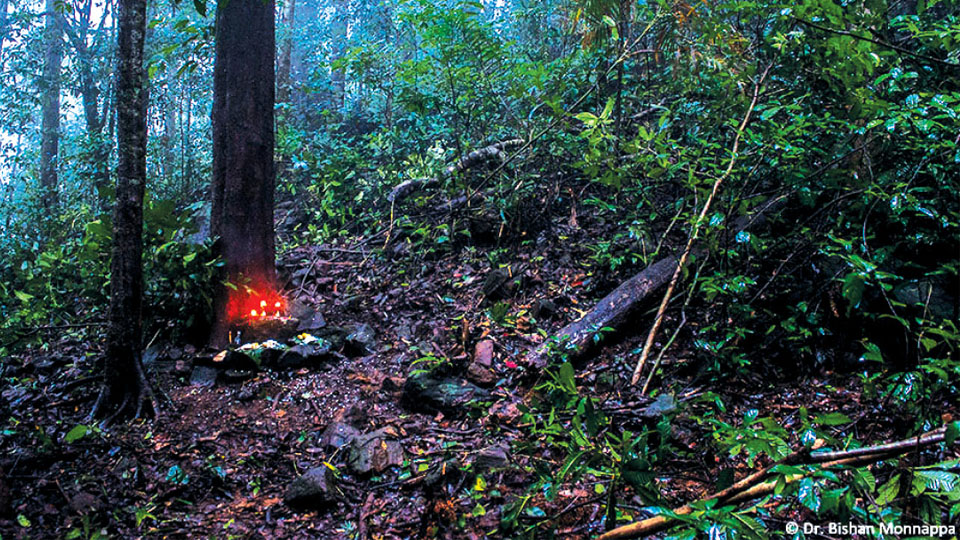
Kodagu district is renowned for its Devara Kadu — sacred groves — and temples nestled within dense, untamed forests. These ecological havens, found in every village across the district, serve as a unifying force for families and diverse communities. Kodagu is home to nearly 1,214 Devara Kadus, spanning 4,614 hectares, where native communities worship folk deities. Activities such as tree felling, lopping, clearing fallen branches, plucking weeds, pruning or burning trees are strictly prohibited within Devara Kadus. It is widely believed that any violation of these sacred rules invites divine retribution, with offenders punished by death at the hands of the presiding folk deity.
Recognising the ecological and cultural importance of sacred groves, the Supreme Court recommended their inclusion under the Wildlife Protection Act, 1972, particularly through Section 36-C, which provides for the declaration of “community reserves.”
To ensure sustainable conservation, the Court proposed empowering local communities that have historically protected these groves.
“The Court deems it necessary to propose certain suggestions to promote the sustainable conservation of sacred groves and empower the communities associated with their protection,” the Bench said. The Scheduled Tribes and Other Traditional Forest Dwellers (Recognition of Forest Rights) Act, 2006 recognises and respects the diverse legal and cultural practices of tribal communities across India.
source: http://www.starofmysore.com / Star of Mysore / Home> News / December 30th, 2024
WELCOME. If you like what you see "SUBSCRIBE via EMAIL" to receive FREE regular UPDATES.
Read More »